Aluminium Windows and Doors in Nigeria 2026: What Every Smart Builder Needs to Know Before They Buy | SIUPA
how to choice production
Aluminium Windows and Doors in Nigeria 2026: What Every Smart Builder Needs to Know Before They Buy
Confused by aluminium window prices in Nigeria? We're a direct Chinese factory. In this 2026 guide, we break down the systems, the quality standards, and what to look for — before you spend a single Naira.
Building a home in Lagos, Abuja, or Port Harcourt is one of the biggest investments you will ever make. And yet, one of the most critical decisions — the windows and doors — is often rushed, misunderstood, or handed off to whoever gives the cheapest quote on the street.
Here's the truth that experienced Nigerian developers already know: a bad window choice will cost you far more in the long run than a good one costs upfront. Rattling frames, leaking joints, rusting hinges, stuck rollers — these are not just annoyances. They are signs that the wrong material, the wrong gauge, or the wrong system was chosen at the start.
In this guide, we break down everything you need to know about aluminium windows and doors in 2026 — from materials and systems to what separates a factory-quality product from the ones flooding the local market.
Why Aluminium Is Still the Professional's First Choice
Walk through any high-end residential development in Lekki, Maitama, or GRA Port Harcourt, and you will notice one thing almost every serious project has in common: aluminium frames. Not PVC. Not steel. Aluminium.
The reason is simple. PVC tends to warp and discolour under Nigeria's intense dry-season heat — the kind of 40°C days that Lagos regularly sees between November and March. Steel, on the other hand, puts up a strong first impression but corrodes rapidly in humid coastal air, especially in areas like Victoria Island or Bonny Island where salt is permanently in the atmosphere.
Aluminium, specifically the 6063-T5 alloy grade used by professional manufacturers, does neither. It does not rust. It does not warp. It handles tropical heat, coastal humidity, and the mechanical stress of daily use for decades without losing structural integrity. For any serious builder — whether you are developing ten units or a single luxury villa — aluminium is not a luxury. It is the only logical long-term choice.
The One Question You Must Ask Every Supplier
Before you agree to any price, before you sign any contract, before a single frame goes into your wall, ask this question:
"What is the gauge of the aluminium profile?"
Gauge refers to the thickness of the aluminium walls in the frame. It sounds technical, but the practical difference is something you can actually feel with your hands. A 0.8mm or 1.0mm profile — which is unfortunately common in low-cost local markets — will flex noticeably if you press the frame. It will rattle in wind. The rollers will wear out fast. Within three to five years, the whole system starts to feel cheap and unreliable, because it is.
Professional-grade aluminium windows start at 1.4mm for standard residential casement and sliding windows, and move up to 1.6mm and 2.0mm for heavy-duty sliding doors and thermal break systems. Our own flagship export products — the ones going into quality builds across West Africa right now — use 2.0mm profiles for windows and 1.6mm to 2.0mm for doors. These are the profiles that feel solid when you slide them, that lock with authority, and that are still performing perfectly twenty years later.
If a supplier cannot tell you the gauge, or if they hesitate when you ask, that is your answer.
Understanding the Two Main Window Systems
Not all aluminium windows are the same. The two systems you will encounter most in the Nigerian market are standard aluminium and thermal break aluminium — and understanding the difference will determine both your comfort level and your running costs.
Standard aluminium windows are a single continuous piece of aluminium from inside to outside. The profile is strong and durable, and for most applications in Nigeria — particularly in naturally ventilated buildings — they perform perfectly well. Our 85 series casement and 90 series sliding windows fall into this category. They are the workhorses of commercial construction: apartment buildings, offices, schools, hotels. The aluminium is real, the hardware is reliable, and the price point makes them accessible for large projects.
Thermal break aluminium windows, on the other hand, have a strip of PA66 nylon inserted inside the aluminium profile, separating the inner and outer faces of the frame. This strip — the "thermal break" — stops heat from conducting through the metal. What this means practically is that on a 38°C afternoon in Abuja, the inside surface of the frame stays cool. Your air conditioning works less hard. Your electricity bill drops. And in the rainy season, you get far less condensation on your glass.
Our 120 Series thermal break sliding window is our most popular export product for residential projects across Africa. It uses a 2.0mm aluminium profile, triple-track design with stainless steel mesh screen, and standard 5+12A+5 double-glazed tempered glass. The reason it travels so well from Foshan to Lagos, Accra, Douala, and Nairobi is that it was designed for exactly this kind of market: a serious residential product at a price that makes sense for volume projects.
Sliding vs. Casement: Which Opening Style Is Right for Your Project?
This is a question we get from Nigerian clients regularly, and the honest answer is that both have their place — it depends entirely on the room, the budget, and the aesthetic you are going for.
Sliding windows and doors are the dominant choice across Nigeria for good reason. They require no clearance space to open, making them ideal for rooms where furniture sits close to the wall. They are easier to operate for older family members. And in a two-track or three-track configuration, they allow generous ventilation even when the opening is partially blocked. The triple-track design — which we use in our 120 series — gives you one fixed pane and two independently sliding panels, so you can control exactly how much air comes in from each side.
Casement windows — the type that swing outward on a side hinge — offer superior weather sealing when closed. Because the sash presses directly against a rubber seal around the entire perimeter, there is almost no gap for wind or rain to penetrate. For a bedroom where you want complete silence and privacy when the window is shut, or for a study where you need to control noise, casement windows have the edge. Our 109 and 112 series thermal break casement windows are designed for exactly this use case: the kind of room where performance matters more than price.
For doors, the conversation is almost always about heavy-duty sliding systems. A sliding patio door connecting the living room to a terrace needs a different product from a bathroom door or a bedroom window. Our PM series heavy-duty sliding door is the product most of our West African clients request first — it is engineered to carry the weight of large glass panels, roll smoothly on its tracks thousands of times, and lock securely enough that security is never a concern.
Glass: The Detail That Most People Overlook Until It Is Too Late
The aluminium frame gets all the attention, but the glass is where a significant portion of your window's performance actually lives. Here is what you need to know before specifying.
Single glass — a single pane of tempered glass — is still found in entry-level products and some bathroom applications. For any main living area window or door, single glass is no longer the right choice in 2026. It offers no meaningful insulation, poor sound reduction, and in a building with air conditioning, it will sweat with condensation on hot days.
Double-glazed tempered glass is the standard we apply to all our residential products. A double-glazed unit consists of two panes of tempered glass with an air gap sealed between them — for example, 5+12A+5 means two 5mm panes with a 12mm air gap. This trapped air acts as an insulating layer, reducing both heat transfer and noise. For the 120 series thermal break windows, this is the standard specification. For our higher-end door systems, we move to wider air gaps — 5+20A+5 or even 5+27A+5 in our top-tier PY series — which gives performance levels comparable to European passive-house products.
One important fact that even experienced buyers are often surprised by: as your window gets larger, the glass automatically gets thicker. A 1.5×1.5m window panel is physically heavier than a 0.8×0.8m window, and the glass needs to be structurally thicker to handle the load safely. Our factory applies this upgrade automatically — you do not need to specify it. But it is worth knowing because it affects the final weight of the shipment and the structural requirements for your wall opening.
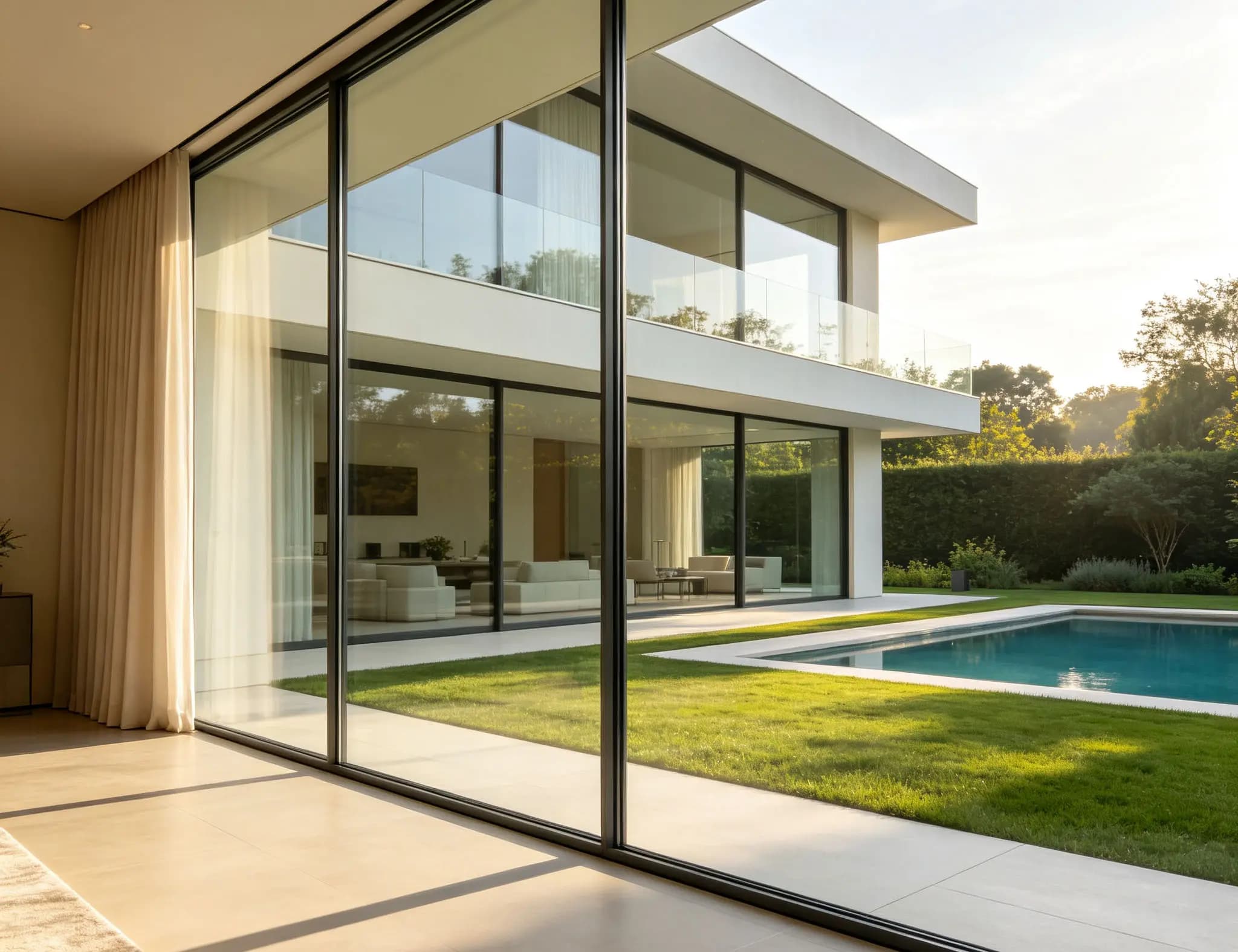
Reflective and tinted glass is extremely popular in the West African market, and for good reason. Our LX Gray Reflective Glass, for example, reflects a significant portion of solar radiation before it enters the room. In a building facing west in Lagos — catching the afternoon sun directly — this can make a meaningful difference to indoor temperature without any additional mechanical cooling. It also gives the façade a sharp, modern appearance that reads as high-quality construction from the street. Other options include Ford Blue reflective glass, various tinted colours, frosted glass for bathrooms, and specialty products like ultra-white fluted glass for architectural feature panels.
If you want Low-E glass — a coating that further reduces infrared radiation while maintaining visible light transmission — this is available as an upgrade on any of our products. High-transparency Low-E is the right choice for most residential applications. Low-transparency Low-E is better for buildings with extreme solar exposure where cooling costs are a primary concern.
The Hardware Question: Where Cheap Windows Really Fall Apart
You can have a perfectly good aluminium frame and decent glass, and still end up with a frustrating window — because the hardware failed. Rollers that grind. Locks that stick. Handles that wobble after six months. This is where the margin goes in cheap products: hardware that looks fine in the showroom but degrades quickly under daily use.
For our sliding window and door products, we use BOGO brand hardware — a professional-grade fitting specification with proven durability in demanding climates. For casement windows, we use VBH brand accessories, which are manufactured to German standards and are the same hardware specification used in European residential construction. Our handles are sourced from Hoppe, a German brand with over 150 years of manufacturing history.
The other hardware element that matters enormously in Nigeria specifically is the insect screen. Mosquitoes are not a minor inconvenience in Lagos or Abuja — they are a genuine health concern. All our window products that include screens use stainless steel mesh rather than the fibreglass or aluminium mesh common in cheaper products. Stainless mesh does not corrode in coastal air, does not tear easily, and maintains its appearance for the life of the window.
Shipping a Full Container to Nigeria: What to Expect
One of the most common questions we receive from Nigerian importers is about logistics — specifically, what does it actually look like to ship a full order from our factory in Foshan to a Nigerian port?
The honest answer is that it is more straightforward than most people expect, provided you work with an experienced freight forwarder. Our factory is located in Foshan, Guangdong Province — approximately two hours from Guangzhou Nansha Port, which is one of the main export hubs for building materials heading to West Africa. Transit time to Lagos (Apapa or Tin Can Island) is typically between 25 and 35 days depending on the shipping line and route.
We pack all our products in plywood crates, which are robust enough to handle the loading, transit, and unloading process without damage to the frames or glass. For a typical villa project — say, thirty to forty windows and eight to ten doors — the shipment usually fills one 20-foot container, sometimes a 40-foot container depending on door sizes.
Our payment terms are straightforward: 50% deposit by TT wire transfer before production begins, and the remaining 50% paid before the container is released for shipping. Production takes approximately 60 working days from the date we receive the deposit and your approved shop drawings. We provide detailed shop drawings — technical drawings showing exact dimensions and specifications for every item — before production starts, so you have a chance to verify everything matches your site measurements.
What We Do Not Do — And Why That Matters
We think it is worth being direct about this: we do not supply 0.8mm or 1.0mm aluminium profiles. These gauges are not structural for any serious window or door application, and we will not put our factory name on them.
We do not use offline Low-E glass coatings, which typically peel or degrade within two to three years. Our Low-E products use an online coating process that bonds the coating to the glass during manufacturing — it will not peel, and the performance guarantee runs for more than ten years of use.
And we do not offer PVC window products at all. Our factory specialises entirely in aluminium systems. We know aluminium deeply — the alloys, the profile designs, the hardware combinations, the glass specifications — and we believe that specialisation produces better results for our clients than being a generalist supplier of whatever the market asks for.
Ready to Start Your Project?
If you are a developer, importer, contractor, or homeowner planning a build in Nigeria — or anywhere across West Africa — we are ready to work with you. Send us your window schedule, your floor plan, or even just a list of rough sizes and quantities, and we will prepare a detailed quotation within 48 hours.
Every quotation we produce includes exact dimensions, series specifications, glass type, hardware brand, and unit pricing — no vague estimates, no hidden charges added later.
Our team speaks English and is familiar with the specific requirements of the Nigerian and West African construction market. We have shipped to Lagos, Abuja, Port Harcourt, Accra, Douala, Abidjan, and Nairobi. We understand the ports, the documentation requirements, and the practical realities of getting product from our factory floor to your building site.